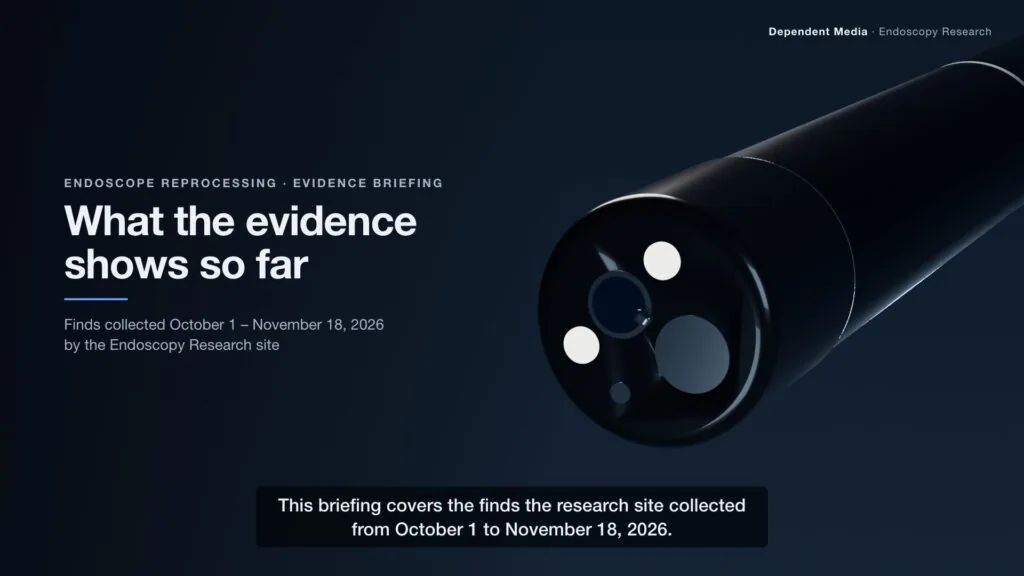
Endoscope reprocessing: what the evidence shows so far
A three-minute narrated briefing on what the research collected from October 1 to November 18, 2026: published studies, FDA reports and recalls, and posts from endoscope support groups. Captions are available in the player.
Transcript
This briefing covers the finds the research site collected from October 1 to November 18, 2026.
A colonoscope like this one carries an instrument channel 3.7 millimeters wide, through an insertion tube about 1.7 meters long.
Beside it run narrower air and water channels.
After every procedure, those channels must be cleaned, disinfected, and dried, before the scope is stored or used again.
How well that is done, and what goes wrong when it isn't, is what this research tracks.
The site collected 216 relevant finds in this period.
190 are FDA device problem reports, 17 are published studies, and 6 are FDA recalls.
Only 3 are Facebook posts, because the Facebook groups were connected on November 18.
The strongest evidence so far is in the published research.
A study at three centers checked 2,744 reprocessing cycles, and found 682 failures. That is about one in four.
The staff doing the brushing were among the predictors of failure.
A pilot study found that skipping brushing or bedside flushing left a residual inflammatory response, which ATP testing did not detect.
A review concludes that biofilm fixed inside channels drives persistent contamination.
Not every study agrees. One, at three hospitals, found results within accepted limits after high-level disinfection.
And no study in this period measured moisture inside the channels directly.
Of the FDA problem reports, 101 name Pentax scopes, and 76 name Olympus.
Most describe a malfunction, and state that no patient harm was reported. An FDA report records a problem. It does not establish the cause.
Posts in a patient support group describe three lawsuits against Olympus, and recalls of duodenoscopes and reprocessors.
These are allegations, reported second hand. They still need checking against FDA and court records.
On practice, the finds so far are FDA reports, not staff accounts.
In one, a rubber gasket from a drying cabinet's tubing separated, and was found lodged inside an endoscope.
Others describe white residue, or foreign material, in the air and water channels.
These reports describe events. They do not show what staff know.
On manufacturer instructions, four Pentax recalls added warnings to ultrasound endoscope instructions, about the water bottle.
No find yet quotes the instructions for drying. That point needs a direct review of the instructions themselves.
So the evidence is strongest in published research, and thinnest where it matters most: staff describing how they dry, brush, and flush.
Since November 18, six Facebook groups are checked every day, and finds from private groups, conferences, and calls can be added by hand.
The next report will show what those voices add.